


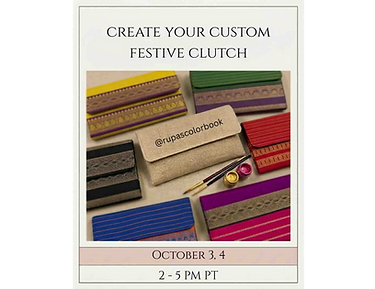
Create your custom saree-inspired clutch
Due to many requests, bringing back the clutch painting session. With festivals around the corner, it’s the perfect time to create custom saree-inspired festive accessories.
Bring your favorite saree/outfit to the session, and we will create a custom clutch that matches your look! Your unique designs will be translated onto elegant, soft, organic jute clutches, crafted by local Indian artisans.
The organic clutch and all materials are included.
-
Surface: Organic artisan jute clutch (9” x 5”)
-
Dates: Oct 3, 4, 2026 (2-day session)
-
Time: 2-5 PM PT
Subscribe here to receive special pricing on the saree-inspired clutch session

Girl Boss - Paint Your Statement Clutch
This International Women’s Day, join me for the Girl Boss - Paint Your Clutch curated session and create a statement piece you will love to carry with you.
We will paint confident, stylish Desi women in kala chashma on a beautifully crafted organic clutch, made by local Indian artisans.
Bring a friend or treat yourself, and celebrate the boldness and creativity of all women.
The organic clutch and all materials are included.
-
Surface: 9” x 5” clutch with handle
-
Date: March 7 & 8, 2026
-
Time: 2–5 PM PT, or until complete :)
Subscribe here to receive special pricing on the Girl Boss session

Chai Ritual - Galentine's Watercolor
Continuing our art journey into watercolor with a cozy Indian lens, painting the chai ritual - the kettle, cutting chai glasses and the warmth of an everyday moment. The focus is on freehand drawing, loose brushwork and soft washes, allowing watercolor to flow naturally. This session is supportive and approachable, guiding you to thoughtfully capture the warm nostalgia.
Bring a friend and celebrate creativity and connection this Galentine’s - you will both leave with a finished piece that feels familiar and personal.
-
Theme: Chai Ritual - Galentine's Special
-
Surface: 11"X14" watercolor board
-
Date|Time: February 14-15, 2026 | 2-5pm PT
Subscribe here to receive special pricing on Chai Ritual watercolor

Kalighat - Occidental style
Building on our last traditional session, we continue exploring the expressive lines and minimalism of Kalighat art—this time through its Occidental style. In this session, we’ll draw inspiration from the iconic Babu-Bibi figures, a hallmark of Kalighat’s social and satirical themes. Relax, create, and leave with a personalized piece that blends heritage with contemporary flair.
-
Theme: Occidental Kalighat - Babu Bibi
-
Surface: 16"X20" prepped canvas board provided (other material list will be shared)
-
Date|Time: November 1,2,8, 2025 | 1-4pm PT
Subscribe here to receive special pricing on Kalighat-Occidental style

Saraswati in Kalighat style
This Navaratri, we honor Goddess Saraswati, the embodiment of wisdom, learning, and creativity. Join us as we celebrate her spirit through Kalighat, a 19th century Bengali art form characterized by flowing lines, expressive faces, and striking minimalism. It originates from patuas, specialized scroll painters, who would engage in their craft at the Kalighat Kali Temple in Kolkata.
Relax, bring your creativity, and leave with a personalized piece to celebrate Navaratri!
-
Theme: Saraswati
-
Surface: 16"X20" prepped canvas board provided (other material list will be shared)
-
Date|Time: September 6-7 2025 | 1-5pm PT
Subscribe here to receive special pricing on Kalighat

Ashtalakshmi in Kalamkari style
Celebrate this Navaratri season with hand painted Ashtalakshmi in Kalamkari style and get ready to enhance your festive decor!
-
Theme: Ashtalakshmi
-
Surface: 24"X30" prepped canvas board provided (other material list will be shared)
-
Date|Time: September 14,15,21,22, 2024 | 2-4pm PT
Subscribe here to receive special pricing on Kalamkari

Sketch Art Series - 1 of 3 wine & grapes
Learn the art of sketching and drawing in this 3-part series.
Sketching is a valuable tool for enhancing creativity, observational skills and visual communication abilities. Series 1 of 3 focuses on still life, and at the end of the session, you will take home a finished display of wine and grapes!
-
Surface: 16"X20" art board
-
Theme: Wine & grapes (graphite on white)
-
Duration: 3 sessions, 3 hrs each
Subscribe here to receive special pricing on sketch art series #1

Warli Art on plate
Bringing back #Warli, the narrative geometric art form and this time, on a plate!
#Warli is an ancient tribal art from western India. Its roots date back to 3000 BCE. Using geometrical mathematics Warli art depicts social life -- pictures of people and animals, along with scenes from daily life, in rhythmic, harmonious patterns.
In this session, we will brush up on Geometry 101, recreate Warli on a prepped 13" plate and take home a finished piece, ready for display.
-
Surface: 13" prepped plate
-
Duration: 2 sessions, 2.5 hrs each
Subscribe here to receive special pricing on Warli

Kerala Mural Workshop - Geetopadesham
Kerala murals stand tall in India’s artistic history, with their technical excellence, spiritualized storytelling, bold strokes, bright colors and uniquely idealized people, animals and trees. These paintings are said to belong to different epochs, from the upper Paleolithic (before the last ice age) to the early historic period. Many of the most exquisite murals were painted during the 15th and 16th centuries, when the second Bhakti movement swept through Kerala. With the invasion of Tippu Sultan and the later takeover of the British, wall-painting art fell out of favor in the 18th century. It took a disaster to halt the decline. In 1970 a fire broke out in Guruvayur Temple, burning down the walls and obliterating the murals. Faced with replacing the masterpieces, temple authorities realized, to their dismay, only three veterans could be summoned for the recreations. It is because of them that we are able to enjoy the wonderful works of art in the temple today.
Kerala murals are typified by their rich, warm and loud colors, and layered shading. A traditional Kerala mural follows the panchavarna (five colors) scheme, using red, yellow, green, black and white. It is this adherence to a limited earthy palette and shading between them that gives the murals much of their distinctive look and feel.
In this session, with Geetopadesham as the theme, we will humbly recreate this vibrant art form, while also learn further interesting facts. The workshop will span 7 sessions of 2 hrs each. At the end of the session you will take home a beautifully hand-painted Geetopadesham on canvas, in Kerala Mural style, ready for display!
Theme: Geetopadesham
Date/Time: 7 sessions, 2 hrs each
Surface: 18”X24” prepped canvas board provided (other material list will be shared)
Subscribe here to receive special pricing on Kerala Mural

Cheriyal Art Workshop
#Cheriyal is Telangana's 400-year-old story telling, scroll art form. It emerged as a popular mode of educating and entertaining the audience, used as visual aid to go with stories from Indian mythology, Puranas and Epics. The Nizams gave the name nakashi, meaning fine lines, to describe this style of painting. Later when the artists moved to the Cheriyal village, the name of the village became synonymous with the art form. Hence Nakashi and Cheriyal art are used interchangeably. The scrolls are usually painted in a vertical format with the stories illustrated in a series of horizontal panels.
With new forms of entertainment, this art of story telling has lost patronage. Now there are only two families in Cheriyal who are still keeping this tradition of Nakashi painting alive! Contemporary artists have adapted traditional techniques to keep the art relevant in the changing times.
In this session, as a humble attempt to revive this style, we will recreate Cheriyal art on 2 wall panels. At the end of the session you will take home 2 hand-painted vertical or horizontal canvas panels, ready for display!
-
Surface: 10"x20" canvas (2 pieces) - will be provided, prepped and ready to paint
-
Date/Time: 4 sessions, 3 hrs each
Subscribe here to receive special pricing on Cheriyal

Pichwai Art in a hybrid setting
#Pichwai is a style of visually stunning painting that originated over 400 years ago, in the town of Nathdwara near Udaipur in Rajasthan. Pich=behind, wai=hanging; these are traditional paintings dedicated to Shrinathji (the 7yo Krishna) and are typically hung behind the idol of the deity in local shrines. These elaborately hand-painted artworks celebrate the different moods and expressions of Krishna, set in various seasons or festivals. Elements like peacocks, lotuses, and cows are featured prominently and repeatedly. Over time, Pichwai painting came to be practiced in various local styles. As an endeavor to preserve and revive this sacred art form, contemporary renditions of the traditional Pichwai are gaining popularity in museums, home decor and more.
In this session, we will recreate the intricate Pichwai art on 9" wooden plates, and learn further interesting facts of this ornate art form.
At the end of the session you will take home two hand-painted 9" wooden plates, ready for display!
This art beautifully emphasizes shading, a building block for other upcoming art forms.
-
Surface: Two 9" readied wooden plates provided (other material list will be shared)
-
Theme: Shrinathji and cow plates
Subscribe here to receive special pricing on Pichwai

Ganjifa Art in a hybrid setting
#Ganjifa derives from the Persian word #Ganjifeh meaning playing card.
This game of cards was brought from Persia to India during the Mughal period and was patronized by the royals. Ganjifa cards were made on materials ranging from ivory, tortoise shells, precious stones for the royals, to wood, palm leaf for the commoners and now paper and cardboard. Over a period of time, this traditional palace game of cards evolved into an art form. Uniqueness of Ganjifa cards is that they are hand-painted, typically on ~4" circular cards using natural colors, and squirrel hair brushes for intricacy and fineness.
Ganjifa has many different styles (Bengal, Kashmir, Himalaya, Orissa, Rajasthan, Karnataka, etc.) exhibiting regional influence in their shades of colors, line, and themes. Mysuru-Ganjifa was extensively patronized by Maharaja Sri Krishnaraja Wadiyar. The main aim of the game was to teach, learn and tell stories from the ancient scriptures.
In this session, get ready to recreate the intricate #MysuruGanjifa art in the present context and learn further interesting facts of this fascinating miniature art form.
At the end of the session you will take home finely hand-painted 10-card Dashavatara set or 5-card Nature set OR perhaps both sets! Arrange them in your favorite configuration and add beauty to any decor!
Among other things, you will learn how to work with ultra fine brushes to create intricate miniature art. And that skill will be a precursor to other upcoming advanced art styles.
-
Surface: 4" circular prepped cards provided (10 for Dashavatara set, 5 for Nature set)
-
Theme:
Option 1: 10-card Dashavatara set
Option 2: 5-card Nature set
Option 3: 10-card Dashavatara set AND 5-card Nature set
Subscribe here to receive special pricing on Ganjifa

Virtual Paint Party
#VirtualPaintParty offers fun and creative way to celebrate with your family, friends, cousins, colleagues, near or far!
Gather a minimum of 6, pick a date/time convenient for your group and join me online to paint!
Style of the month: Madhubani
Date/Time: You and your group pick!
For this online event, material list will be shared, to bring.
Subscribe here to receive special pricing.

Pattachitra Art
In Sanskrit, patta means cloth and chitra means picture -- #Pattachitra is a traditional scroll painting from Odisha, and the origin of this intricate art form dates back to the 5th century B.C.E. Pattachitra developed around the premises of Puri temple, the theme typically inspired by Jagannath. The paintings continue to carry the legacy of the Indian mythology and folklore long forgotten. The finest paintings can be found in the World Heritage Village of Raghurajpur. The uniqueness of the paintings is showcased by their floral borders, which is a must in Pattachitra. In the traditional method, the preparation of the patta begins with the cloth treated with chalk powder mixed with starch (made from crushed tamarind seeds), and the colors used are natural and organic.
In this session, we will explore Pattachitra art in its contemporary context, learn other interesting facts behind this beautiful art form, and complete a beautiful Pattachitra painting!
-
Surface: Canvas - 16"X20"
Subscribe here to receive special pricing on Pattachitra

TRIDEVI - 3 Art Styles
Tridevi celebrates the 3 divinities (Durga, Lakshmi, Saraswati) in 3 art styles (Kalamkari, Warli, Madhubani)
At the end of this session, you will take home 3 finished Devi paintings,
in 3 different art styles, to highlight your decor!
-
Surface: 3 Canvas - 11"X14" each
-
Duration: 3 days, 4 hrs each
Subscribe here to receive special pricing on Tridevi

Phad
#Phad is a 700-year-old art style from Rajasthan, done on a long piece of cloth or canvas, known as phad, and created as mobile temples. The painting legacy was passed down over generations within a single family -- the Joshis of Bhilwara!
Joshis were commissioned by travelling priests to create Phad painting scenes. The paintings were carried as accompaniments by the priest (& his wife) who did musical performances of local deities. The Phads would be un-scrolled after sundown, and the performance would last into the night. These folk ballads in scroll style formed beautiful piece of visual story-telling!
Traditionally these elaborate paintings are done on wide scrolls (15 to 30 feet) to accommodate the numerous episodes of the complex stories. The process to create a Phad is completely organic -- from the canvas made of khadi fabric, to the paint colors made from the extracts of vegetables, everything is eco-friendly. Phad paintings are two dimensional, and typically the characters face each other and not the viewer. Since the tradition of Phad art was so closely guarded, the art form faced threats of fading. Revival efforts are in the works now to extend the art beyond the Joshi family.
Here's TEDx talk by Phad artist, Kalyan Joshi on keeping the art alive.
In this session, we will explore Phad art in the contemporary context, learn other interesting facts behind this beautiful narrative art form, and take home a finished Phad!
-
Surface: Canvas - 16"X20"
-
Duration: 3 days, 3 hrs each
Subscribe here to receive special pricing on Phad

Kalamkari
Kalam (pen), kari (work) -- #Kalamkari is an ancient art of organic fabric painting and block printing, dating back to 3000 B.C.E., with evidences found at Mohenjo-daro sites.
Kalamkari mainly flourished in Andhra Pradesh, gained recognition during the Mughal era, and 2 distinct styles have evolved from Srikalahasti and Masulipatnam regions.
-
Srikalahasti style draws inspiration from Hindu mythology and folklore, characterized by free hand drawing, using the kalam.
-
Masulipatnam style has Persian influence, motifs block printed with hand-carved traditional wooden blocks and intricate detailing hand painted.
Traditionally Kalamkari involves ~23 tedious steps of dyeing, bleaching, hand painting, block printing, starching, cleaning and more, using natural dyes and organic materials.
In this session, we will have fun exploring Kalamkari using today's tools and take home a finished art!
-
Surface: Canvas - 16"X20"
-
Duration: 3 days, 3 hrs each
Subscribe here to receive special pricing on Kalamkari

Tikuli
#Tikuli (aka bindi - colorful dots that women accessorize between eyebrows and symbol of feminine power in India) has a strong influence on the Tikuli art - an 800 year old, lesser-known, rare specialty from Bihar.
Traditionally, Tikuli art was limited to decorative bindi making - dissolving glass, blowing it into a thin sheet, creating colorful designs and decorating with gold and gems. Since it involved intricate craftsmanship, it was the sole privilege of the royalty in India. This art was further patronized by the Mughals, and traders from all over came to Patna to purchase this art in large quantities. The decline of the Mughals and the advent of colonialism led to the near extinction of Tikuli art. In 1954 it was brought back to the modern mainstream by Chitracharya Padmashree Upendra Marathi, who portrayed Tikuli art on hardboards. Craftsmen are since undertaking efforts to revive the art in the contemporary context.
Making Tikuli art is a delicate and tedious process. It starts by preparing the painting surface. 4-5 coats of black paint is applied and after each coat, the surface is sandpapered. Ornate designs are then drawn and painted on the prepped surface.
In this session we will explore Tikuli art close to it's roots using contemporary tools, and take home a finished masterpiece!
-
Surface: Canvas - 16"X20"
-
Duration: 3 days, 3 hrs each
Subscribe here to receive special pricing on Tikuli

Madhubani Art Workshop
#Madhubani or #Mithila painting is ~2500 year old folk art from Bihar and is said to date back to the time of Ramayana, when king Janaka asked an artist to capture his daughter Sita’s wedding to Rama. These paintings were chanced upon in 1934 in the interior walls of homes, during a massive earthquake that hit Bihar. Madhubani paintings are characterized by bright colors made from natural dyes, with rarely any blank spaces. Themes include natural elements, and figures have prominently outlined, bulging fish-like eyes and pointed noses.
In this session, we will recreate Madhubani using modern day materials and take home a displayable piece.
-
Surface: Canvas - 16"X20"
-
Duration: 3 days, 3 hrs each
Subscribe here to receive special pricing on Madhubani

Gond Art Workshop
#Gond (Dravidian expression for 'the green mountain') is a tribal art practiced by one of the largest tribes in India with whom it shares its name. The tribe is predominantly from Madhya Pradesh and their origin can be traced to the pre-Aryan era. The Gonds put a lot of effort into making their 'story-telling' paintings beautiful, as they believe good image brings good luck. Gond is created from carefully drawn lines -- lines are used in a way to convey movement to still images, dots and dashes are used for greater sense of movement. And the art is expressed in bright vivid colors using natural dyes.
Gond paintings bear strong resemblance to the Australian Aboriginal art.
In this session we will recreate the art from present day tools, and take home a finished piece.
-
Surface: Canvas - 16"X20"
-
Duration: 3 days, 3 hrs each
Subscribe here to receive special pricing on Gond

Warli Art Online Workshop
#Warli is an ancient tribal art from western India. Its roots date back to 3000 BCE, but it gained recognition only in the 1970s. Traditionally painted white (rice paste+water) on mud walls, Warli art depicts social life -- pictures of people and animals, along with scenes from daily life, in a loose, rhythmic pattern.
In this workshop, we will recreate Warli using present day materials and take home a finished piece, ready for display.
-
Surface: Canvas - 16"X20"
-
Duration: 3 days, 3 hrs each
Subscribe here to receive special pricing on Warli
Request a Private Group of 8